IBM i: A Natural Platform for Agentic AI

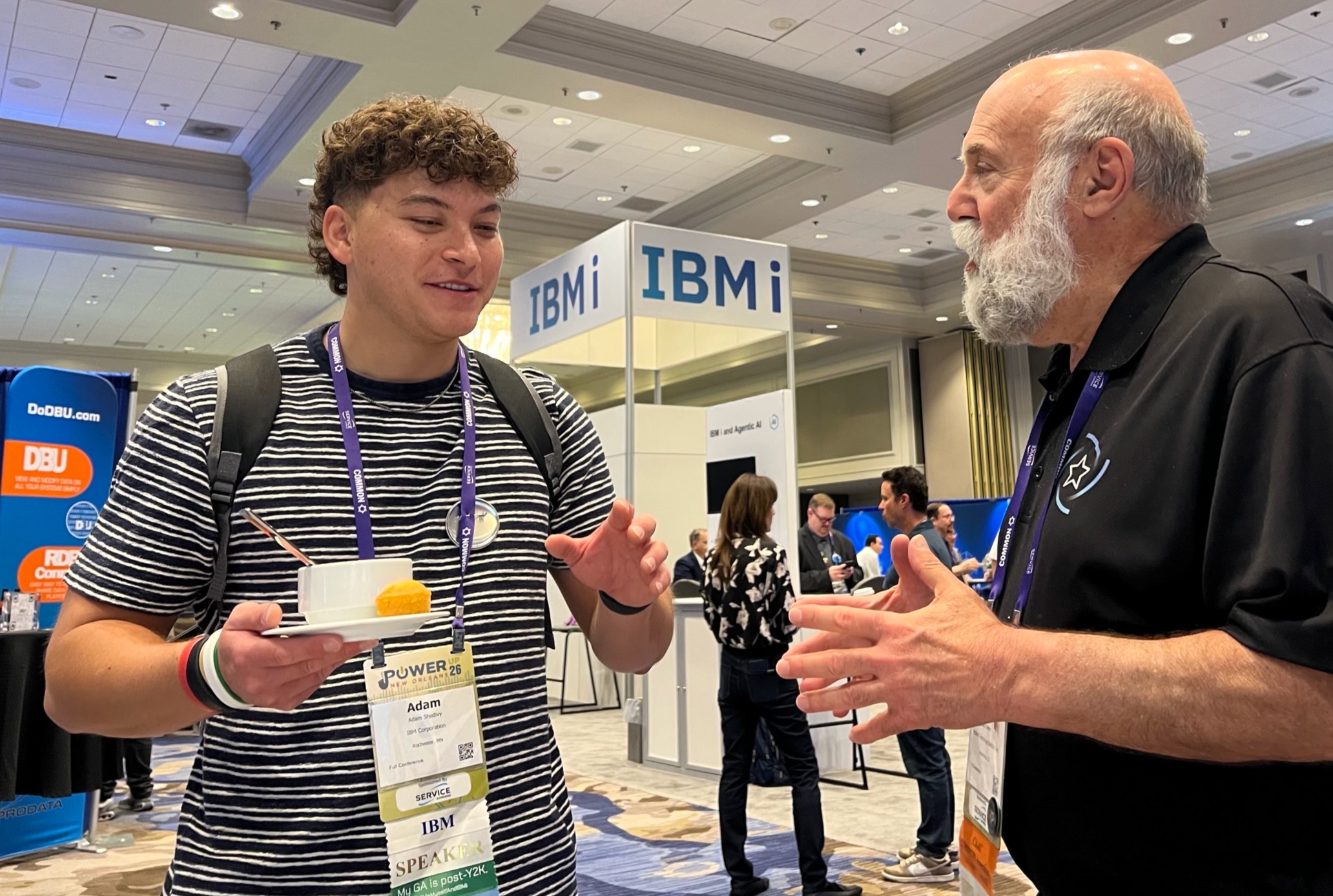
Adam Shedivy and Jack Woehr at PowerUp 2026

Adam Shedivy and Jack Woehr at PowerUp 2026

At the April 2026 COMMON PowerUp conference in New Orleans, IBM’s Adam Shedivy presented a compelling vision of IBM i as an “agentic-native” operating system. Adam observed that IBM i’s integrated architecture provides what agentic AI needs: business data, operations, security, authority, and auditability.

Let’s see what makes IBM i an agentic-native platform.

Integration is the key

While useful for humans, the integrated nature of the IBM i platform becomes even more potent for agentic AI. Here, the operating system, Db2 database, object model, user profiles, job management, command environment, security model, audit journals, and system services are part of the same platform.

As a result, authorized agents can observe, understand, and take action, all within established, governed interfaces, rather than a loose collection of disconnected tools.

SQL services add even more consistency for agents

Using the growing collection of IBM i Services and Db2 for i Services, agents can query system information with SQL instead of relying on green-screen commands.

For agents, SQL Services create a consistent interface to the platform that can help answer questions such as:

  • Which jobs consumed the most CPU overnight?
  • Which user profiles have authority settings that deserve review?
  • What changed on the system recently?
  • Why did a particular order, invoice, or batch process fail?

Security Must Be Enforced by the Platform

Agentic AI becomes risky when an agent can act without boundaries. Although a prompt can suggest that an agent not access payroll data, a better design is to run the agent under an identity that cannot access payroll data.

IBM i has a mature security model that controls access in a consistent manner throughout the database and the operating system itself, with additional database safeguards such as Row and Column Access Control (RCAC). These controls are enforced universally for all users and applications, including AI agents.

A new view of IBM i in the agentic era

As we all move forward modernizing our applications, we leverage IBM i as a near-ideal environment for putting agentic AI to work, even being “agentic-native,” as Adam Shedivy puts it.

We can help you get started with AI with IBM i. Get in touch for an AI strategy session or for any other assistance in turning old AS/400 perceptions to modern IBM i power.

Your “AS/400” Is a Modern IBM i Platform

During a recent client visit, a executive told me that his company was still running an AS/400. His employees had criticized the system as outdated and risky. He defended it because it was stable and reliable, but he also seemed to accept the idea that it was old.

I explained that while the company may once have had an AS/400, today they were running IBM i on Power hardware. They were using it like an old system, but it is modern technology, capable of much more. The executive was pleased and wanted to learn more.

Backward-compatible and future-powered

IBM i’s compatibility with older applications is one of its strengths. A company can continue running proven green-screen software while supporting newer technologies and business requirements.

I reminded the executive that his IBM i system was already running some modern applications, including a PHP-based web portal. What’s more, his system had the potential to integrate with outside services, such as payroll, shipping, customer portals, reporting tools, and other systems through APIs.

IBM i offers an integrated design. The operating system, Db2 database, security model, work management, and application environment work as a team. This architecture supports IBM i’s reliability, data integrity, and security, making it attractive to varied businesses, including retailers, banks, manufacturers, distributors, and insurance companies.

That does not mean every IBM i environment is automatically modern. Some applications need modern web interfaces or API architecture. Integrations may need to be improved. Some systems need updated table design, security practices, newer open source tools, or better development workflows.

AI Potential

As companies explore AI, IBM i systems offer more than the trusted business data and rules that AI tools would need to access. IBM i offers a consistent, integrated, secure environment with a world-class database and a universal SQL interface. As a result, I’ve heard IBM i described as “the first agentic-native operating system.”

Going from AS/400 to IBM i

If you can imagine it, you can do it on IBM i. Backward compatibility lets you move at your own pace.

Now is the time to dream big, call the platform by its right name, and use the power that IBM has given us with this fascinating business platform.

Contact the Seiden team to explore new possibilities for your IBM i applications.

MCP + AI for IBM i Teams (with a MongoDB example)

The Model Context Protocol (MCP) standard defines how AI tools connect to systems such as databases, services, and internal utilities. Instead of every AI product inventing its own custom connector, MCP provides a standard interface.

A good example comes from Seiden Group’s Jack Woehr in his article A Simple MongoDB MCP Server Agent. Jack was also just named MongoDB Creator of the Month. (MongoDb is a flexible NoSQL database that can manage large amounts of unstructured or semi-structured data.)

If you’re attending conferences this year, Jack will be talking about AI at NEUGC (April 7–9, 2026) and at COMMON POWERUp 2026 (April 27–30), where his sessions include “Using Large Language Models” and “AI on Power.”

Why IBM i teams should care

Most IBM i shops already live in a hybrid world: RPG + Db2 + CL alongside open source, APIs, web apps, and, increasingly, AI. MCP matters because it points toward a future where:

  • you don’t need a one-off integration for every AI experiment
  • you can put governance and guardrails around what AI can touch
  • you can modernize incrementally, bridging systems instead of rewriting them

MCP fits for IBM i because it helps make AI integration projects more standardized and repeatable.

How Seiden Group can help

At Seiden Group, we’re focused on practical modernization and development. If you’re exploring any mix of:

  • AI enablement (use cases, architecture, guardrails)
  • MongoDB in a hybrid IBM i environment
  • IBM i development and modernization (RPG, COBOL, SQL, APIs, open source)

We can help you evaluate options, build proof-of-concept projects, and implement production-ready solutions.

Get in touch to chat with us about your options.

Seiden PHP+ Delivers PHP 8.5 to IBM i

PHP on IBM iEach year brings a new PHP release. We’ve prepared Seiden PHP+ so that IBM i users can adopt PHP 8.5 shortly after it becomes generally available (GA) around November 20, 2025. As I mentioned in Keep Your PHP Secure: Why Regular Updates Matter, PHP users should adopt a regular upgrade schedule to make upgrades easier.

November 20, 2025 UPDATE
PHP 8.5 and Seiden PHP+ 8.5 are both available as of today.

Notable Enhancements in PHP 8.5

Two updates stand out to me:

Read more

Keep Your PHP Secure: Why Regular Updates Matter

Seiden PHP+Cybersecurity best practices require regular security assessments, including for PHP.

We recommend installing PHP patch releases at least quarterly. You can review all regular PHP updates, including CVE security fixes, on the php.net changelog page. Our Seiden PHP+ changelog provides additional updates that we include in our supported Seiden PHP+ package.

Read more

Ransomware Lessons from Brussels Airport and IBM i

API & web security on IBM iAt Brussels Airport recently, I noticed airline staff working from paper passenger lists because their digital systems were unavailable. The EU Cybersecurity Agency (ENISA) later confirmed the disruption was caused by a ransomware attack on a third-party airline system (Reuters report).

Read more

A New Generation Shapes the Future of IBM i

In recent months, I have seen an unmistakable, growing wave of younger professionals choosing to invest their energy and creativity in the IBM i platform. This trend was particularly evident at the 2025 PowerUp conference.

Read more

When Your IBM i Email Delivery Fails with Office 365 or Gmail

Google_MailWe’ve been receiving about one request per week to help clients troubleshoot or fix SMTP email issues on IBM i systems—especially when sending to Microsoft (Office 365) and Gmail accounts.

These problems can affect a wide range of systems, including:

Read more

Mapepire Q&A

A friend in the IBM i vendor community asked me about Mapepire from a popularity and security perspective. He had read about Seiden Group’s support for the Mapepire Db2 for i driver. I have provided his questions and edited versions of my answers below.

Read more

Seiden Group Now Supports Mapepire for Node.js and Db2 for IBM i Connectivity

Mapapire database driver for IBM iSeiden Group is pleased to announce that we now provide production support for the open source Mapepire database connector for IBM i. This includes support for Node.js applications and cloud-based or containerized workloads that connect to Db2 for i—whether from IBM i itself or from external systems.

Many developers already rely on Mapepire every day—sometimes without realizing it—because it’s the back-end to the Db2 for i extension for VS Code. We’re excited to help clients adopt this lightweight, high-performance connector.

Read more